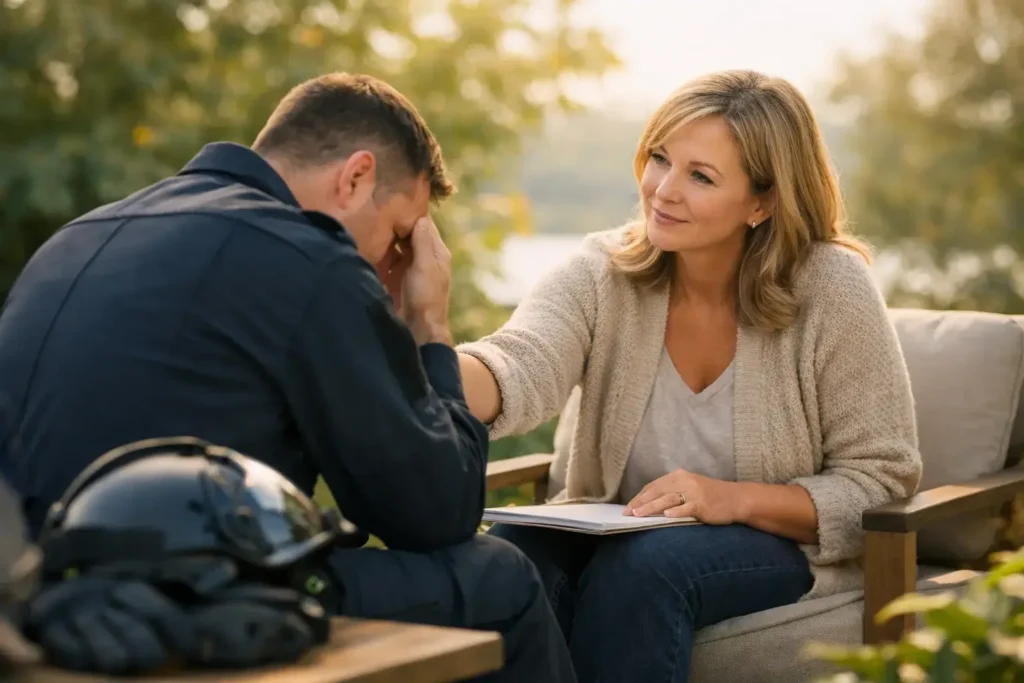
A call may end, a shift may finish, and everyone around you may expect life to return to normal. Yet your body can remain on alert long after the immediate danger has passed. First responder trauma counselling offers a private, compassionate space to make sense of what you have seen, carried, and pushed through – without asking you to minimize the impact of your work.
First responders are trained to act when others cannot. That strength can make it difficult to recognize when support is needed. Seeking therapy is not a sign that you are unable to do your job. It can be a meaningful way to protect your wellbeing, your relationships, and the parts of you that exist beyond the uniform or role.
Why trauma can look different for first responders
A single critical incident can leave a lasting mark. For many first responders, however, distress is not connected to only one event. It may build gradually through repeated exposure to injury, loss, violence, uncertainty, or situations where there was no outcome that felt right.
Trauma does not always arrive as a clear memory or a dramatic reaction. It can show up as irritability after work, difficulty sleeping, feeling emotionally numb, avoiding certain places or conversations, or being unable to relax on days off. Some people notice a shorter fuse at home. Others become highly self-reliant, withdrawn, or constantly busy because stillness feels uncomfortable.
There can also be a form of pain tied to moral injury. This may arise when someone feels they could not do enough, had to make an impossible decision, or witnessed suffering that conflicted with their values. These experiences deserve care. They are not evidence of weakness or failure.
Signs it may be time to reach out
There is no single threshold that determines whether therapy is warranted. You do not need to be in crisis, have a diagnosis, or be certain that your experience “counts” before speaking with a therapist. Often, support is most helpful when the strain is beginning to affect daily life rather than after it has become unbearable.
It may be time to consider first responder trauma counselling if work memories keep intruding when you are trying to sleep or connect with others. You may feel chronically on edge, detached from people you love, angry in ways that do not feel like you, or increasingly reliant on alcohol, substances, overwork, or isolation to get through the day. Physical symptoms can matter too, including headaches, stomach distress, exhaustion, racing thoughts, and a nervous system that rarely feels settled.
Relationship changes are another important signal. Partners and family members may not understand why you seem distant, guarded, or quick to react. At the same time, it can feel unfair or unsafe to bring work home. Therapy can help create language for these experiences while respecting both your privacy and your need for connection.
What first responder trauma counselling can offer
Effective trauma therapy does not require you to recount every detail before you feel ready. A trauma-informed therapist works at a pace that supports safety, choice, and trust. The goal is not to erase difficult memories or take away the qualities that help you serve. It is to reduce the hold those experiences have on your nervous system and your life.
Counselling may begin by helping you understand your stress responses. Hypervigilance, avoidance, emotional shutdown, and anger often began as protective strategies. When they continue outside the situations that require them, they can become exhausting. Recognizing their purpose can replace shame with curiosity and create room for new responses.
Depending on your needs, therapy may draw from evidence-based approaches such as cognitive behavioral therapy, acceptance and commitment therapy, dialectical behavior therapy, internal family systems, compassion-based care, or family systems work. The approach should fit the person, not the other way around. Some clients want practical tools for sleep, grounding, panic, and emotional regulation. Others need a place to process grief, identity shifts, guilt, or the effects of long-term cumulative stress. Many need both.
The value of a therapist who understands the culture
First responder work has its own language, humor, expectations, and pressures. A therapist does not need to have lived your exact role to offer meaningful care, but it helps when they understand the realities of repeated exposure, shift work, confidentiality concerns, and the belief that you should simply handle it.
Feeling respected matters. You should not have to educate your therapist about why a call stayed with you, why a routine situation can trigger a strong reaction, or why trust may take time. Counselling should be a place where your competence is honored alongside your pain.
It is also reasonable to ask questions before beginning. You might ask about a therapist’s trauma training, experience supporting first responders, and the approaches they use. The relationship matters as much as the method. If you do not feel heard after giving the process a fair chance, it is okay to seek a different fit.
Supporting the person behind the role
Trauma rarely affects only one area of life. It can shape how you parent, communicate with a partner, sleep, socialize, and see yourself. For some people, the hardest part is not the memory of an incident but the sense that they no longer recognize who they have become.
Individual therapy can offer room to rebuild that connection. Couples or family counselling may also help when loved ones are caught in cycles of silence, conflict, caretaking, or misunderstanding. The purpose is not to make family members responsible for healing trauma. It is to help everyone understand what is happening and find more supportive ways to respond.
This work may include making space for identity beyond service. First responders often carry a deep commitment to helping others, and that commitment is worthy of respect. Still, a sustainable life needs more than endurance. Rest, enjoyment, friendship, values, and meaningful relationships are not distractions from resilience. They are part of it.
Virtual care can make support easier to access
For people managing shifts, commutes, family responsibilities, or a preference for privacy, virtual counselling can be a practical option. Meeting by secure video or phone can reduce the time and energy required to attend a session and make it easier to maintain care during changing schedules.
Virtual therapy is not the right fit for every situation. Some people feel more comfortable in a shared physical space, while others appreciate being able to speak from a familiar, private setting. What matters is having a confidential environment where you can focus and a therapist licensed to provide care where you live. For residents of British Columbia and Ontario, Rising Minds Counselling and Psychotherapy provides compassionate online support grounded in trauma-informed, evidence-based care.
If you are in immediate danger, worried that you may harm yourself or someone else, or unable to stay safe, contact emergency services or a crisis service right away. Therapy is a valuable source of ongoing support, but urgent safety needs deserve immediate help.
Taking the first step without having all the answers
You do not need a perfectly organized story to begin. You can start with something as simple as, “I am not sleeping,” “I cannot switch off after shift,” or “My family says I have changed.” A good therapist will meet you there.
Healing from occupational trauma is rarely about becoming the person you were before. It can be about becoming more connected to yourself, more able to rest, and more able to receive care without losing the strength you value. You have spent time responding when others needed help. You deserve a place where someone can walk alongside you, with steadiness, respect, and hope.